
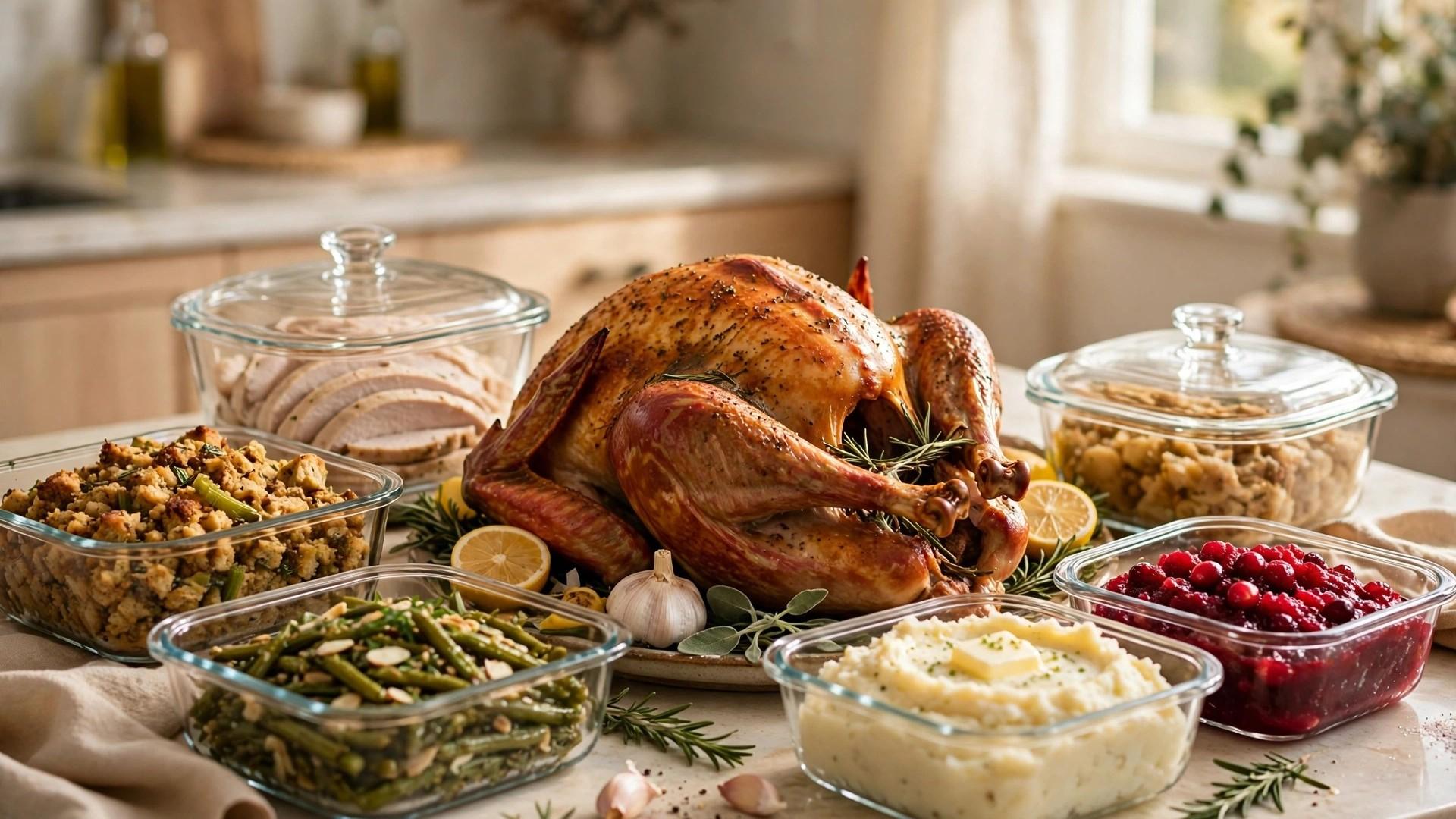

Thanksgiving dinner is one of the biggest meals of the year — and one of the biggest food safety challenges. A whole turkey, a table full of side dishes, and a kitchen full of people create perfect conditions for bacteria if food is not handled properly.
The good news is that the rules are simple, and they come from the US Department of Agriculture. Follow them, and your leftovers will be safe on Sunday as well as delicious on Thursday.
How Long Is Turkey Safe in the Fridge?
The USDA's headline rule is easy to remember: cooked turkey is safe in the refrigerator for 3 to 4 days. That means turkey served on Thanksgiving Day should be eaten, or frozen, by Sunday at the latest — Monday is already too late.
The same 3-to-4-day window applies to most dishes on the table: cooked ham, chicken, stuffing, mashed potatoes, casseroles and other cooked sides. Gravy is the exception: it lasts only 1 to 2 days in the fridge, so use it quickly or freeze it.
In the freezer, the rules relax. Cooked turkey keeps its best quality for 2 to 6 months, and remains safe indefinitely while frozen. If you will not finish the leftovers within four days, freezing them on day one is the smartest move.
What Is the 2-Hour Rule?
The most important number in food safety is not a temperature but a time: two hours. Cooked food should be refrigerated within 2 hours of coming off the stove or out of the oven. After that, bacteria begin to multiply rapidly.
The reason is the "danger zone" — between 40°F and 140°F, where bacteria grow fastest. Food left on a buffet table cools into that range quickly, and every passing hour gives bacteria more time to double. That is why the USDA is blunt: do not leave the turkey out while everyone lingers over dessert.
How Should You Store Leftovers?
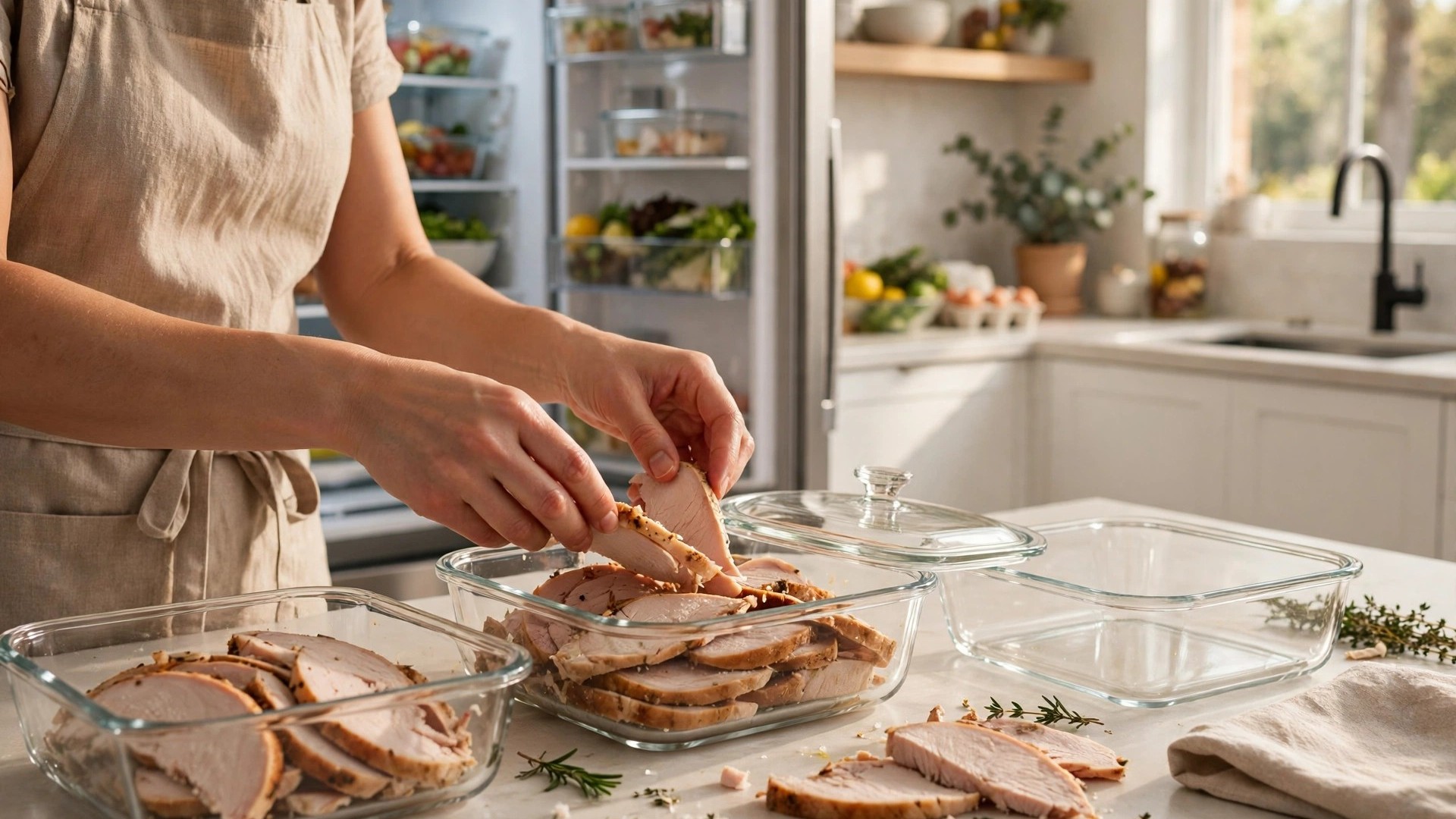
How you pack food matters almost as much as how fast you pack it. The USDA recommends shallow containers — no more than two inches deep — because food cools faster and more evenly in a shallow layer. A deep container of mashed potatoes can stay warm in the middle for hours.
Stuffing deserves special attention. Store it separately from the turkey, in its own container, and never leave it inside the bird overnight. Stuffing inside a turkey cools slowly and can harbour bacteria even when the meat is fine.
How Do You Reheat Leftovers Safely?
Leftovers are only as safe as their second heating. The USDA says all leftovers must be reheated to an internal temperature of 165°F, measured with a food thermometer — not guessed by touch or by how hot the plate feels.
That 165°F rule applies to turkey, stuffing, casseroles and gravy alike. Sauces, soups and gravy should be brought to a rolling boil. Microwaving is fine, but it heats unevenly — stir or rotate the food partway through and let it stand before checking the temperature.
This is where the advice from our earlier guide to cooking your turkey safely comes full circle: the same thermometer that told you the turkey was done on Thursday tells you the leftovers are safe on Saturday.
What If the Power Goes Out?
This year's Thanksgiving came with a complication: a nor'easter knocked out power to more than 26,000 customers in North Carolina alone, with outages across the Northeast. A fridge full of leftovers is no good if the fridge is not running.
The USDA's guidance is precise. A refrigerator keeps food safe for about 4 hours if the door stays closed. A full freezer holds its temperature for about 48 hours, a half-full one for about 24. Every time the door opens, cold air escapes and the clock speeds up.
If power has been out for more than four hours and the fridge has risen above 40°F, perishable food — turkey, stuffing and gravy — should be thrown away. When in doubt, the USDA's advice is blunt: throw it out. No leftover is worth a case of food poisoning.
For anyone travelling in the storm, it is doubly difficult. With 81.5 million Americans on the move, many families are eating leftovers far from home — check our report on Thanksgiving travel 2026 and what to expect before heading home with a cooler full of turkey.
When Should You Throw It Away?
The simplest rule is the calendar: refrigerated turkey older than four days goes in the bin. Other warning signs: slimy texture, an off smell, or any mould — discard immediately, whatever the date says.
Never taste food to check whether it is safe. Bacteria that cause food poisoning do not always change the taste, smell or appearance of food, and a small taste can be enough to make you ill. If unsure, throw it out.
The holiday brings other health risks too. With Thanksgiving travel in full swing, officials are watching a measles outbreak in Pennsylvania that has claimed nine lives — see our report on the measles outbreak and what families need to know.
Final Thoughts
Thanksgiving leftovers are one of the great pleasures of the holiday — the turkey sandwiches, the late-night fridge raids, the soup made from the carcass. The rules are simple: refrigerate within two hours, eat refrigerated turkey within three to four days, freeze what you cannot finish, and reheat everything to 165°F.
Disclaimer: This article is for informational purposes only and does not constitute medical or food safety advice. The guidance cited is from the US Department of Agriculture. Readers with health concerns or questions about foodborne illness should consult a healthcare professional or call the USDA Meat and Poultry Hotline at 1-888-674-6854.