CMCrypto Market in Shock: Binance Hit by Record $6.3 Billion Hack as Bitcoin and Ethereum Prices Fall
The financial industry is entering a new era as traditional financial institutions move closer to blockchain technology. The Depository Trust & Clearing Corporation (DTCC), one of the most important organizations in the US financial market, has officially launched a new tokenization service that could change how stocks, bonds, and other financial assets are managed.
Announced on October 28, 2026, the new DTCC Tokenization Service is designed to bring traditional financial assets onto blockchain networks while keeping them connected to regulated financial market infrastructure.
The development is attracting attention across the cryptocurrency and financial technology industries because it shows that blockchain is no longer being explored only by crypto companies. Major financial institutions are now bringing the technology into their existing systems.
What Is DTCC and Why Does Its New Service Matter?
DTCC plays an important role in the US financial system. Its subsidiaries help process, settle, and maintain records of securities transactions involving banks, brokers, investment firms, and other financial institutions.
In simple terms, DTCC helps make sure that financial assets are properly transferred and recorded when investors buy or sell securities.
Its new tokenization service allows eligible securities held by the Depository Trust Company to be represented as digital tokens on supported blockchain infrastructure.
This is important because it connects blockchain technology with one of the largest established financial market systems.
Rather than replacing traditional financial markets overnight, the service aims to bring blockchain-based tools into an existing regulated environment.
What Is Asset Tokenization?
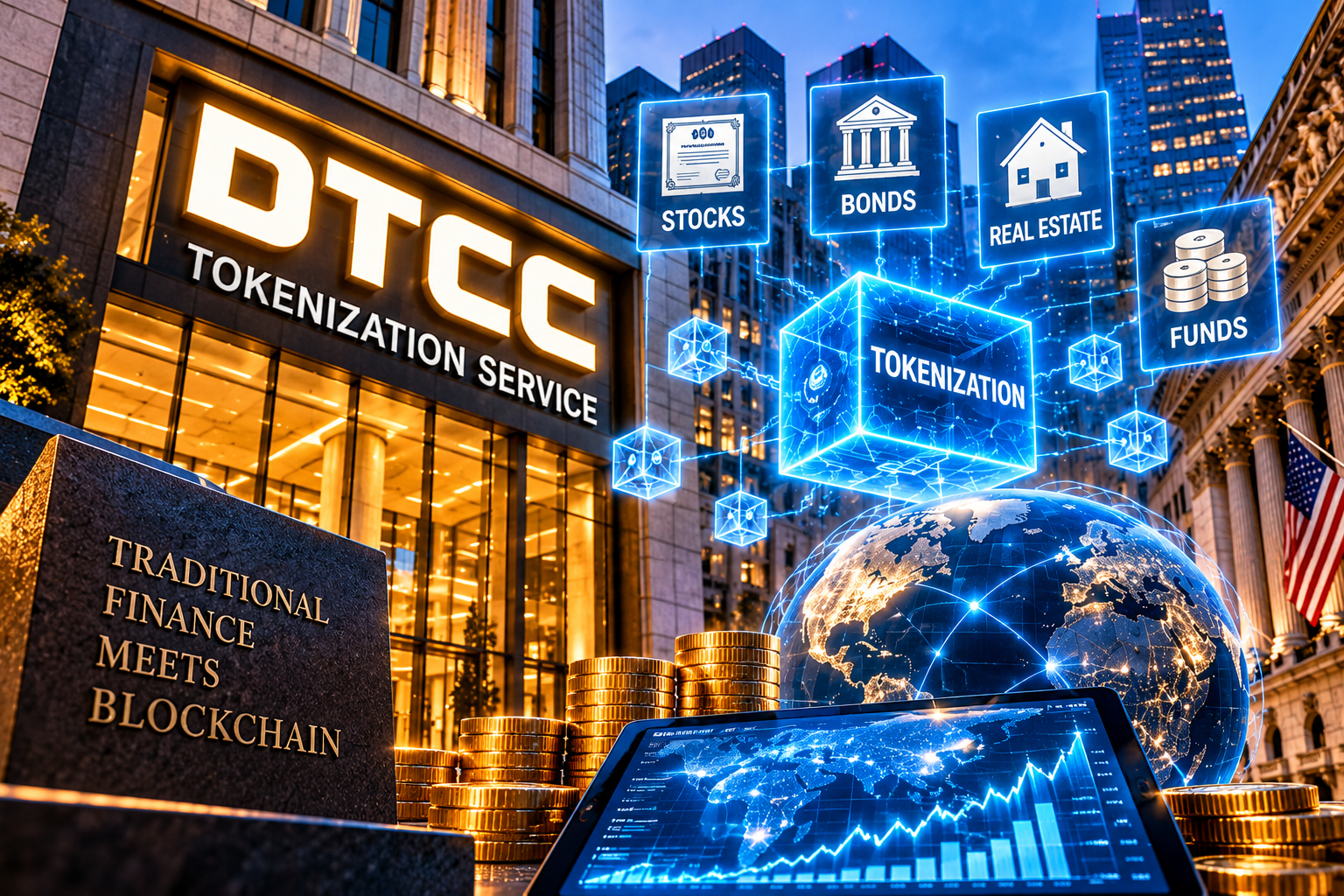
Asset tokenization means creating a digital representation of a real-world financial asset on a blockchain.
For example, imagine an investor owns shares in a company. Through a tokenization system, an eligible representation of those shares can be issued and managed digitally.
The token represents rights connected to the underlying asset, subject to the legal and operational arrangements of the product.
Tokenization can be used for several types of assets, including:
Company shares and equities
Government bonds
Corporate bonds
Money market funds
Real estate interests
Investment funds
Other financial instruments
The biggest advantage is that blockchain can help automate certain processes that traditionally require several financial intermediaries.
How Can Tokenization Change Financial Markets?
Traditional financial transactions often involve multiple organizations, databases, and settlement systems.
When an investor purchases a security, different institutions may need to verify the transaction, update ownership records, process payments, and complete settlement.
Blockchain technology offers another way to coordinate these activities.
Here are some potential benefits.
1. Faster settlement
Tokenized financial assets can potentially move through digital systems more quickly than traditional processes. This could reduce the time required to complete certain transactions.
2. Improved transparency
Blockchain networks can provide shared transaction records, allowing authorized participants to verify activity more efficiently.
3. Better collateral management
Financial institutions frequently use securities as collateral when borrowing or managing financial risks. Tokenization could make eligible assets easier to transfer and mobilize.
4. Greater operational efficiency
Smart contracts can automate specific activities, reducing manual work and the need for repeated data checks.
5. New investment opportunities
Tokenization could eventually make certain financial products easier to distribute and access, depending on regulations and eligibility requirements.
Why Are Banks and Investment Companies Interested in Tokenization?
DTCC is not the only major organization exploring blockchain-based financial services.
Financial institutions around the world are investing in digital asset infrastructure.
Investment managers are exploring tokenized funds, banks are testing blockchain-based payments, and financial technology companies are developing platforms for digital securities.
In another important development, Franklin Templeton and Animoca Brands announced a collaboration in October 2026 to expand institutional access to tokenized real-world assets.
These developments suggest that traditional finance is increasingly interested in using blockchain for practical financial activities rather than simply trading cryptocurrencies.
The goal is to make financial services more efficient, transparent, and accessible to eligible participants.
Will Tokenization Replace Traditional Stock Markets?
Not immediately.
Although tokenization offers several advantages, traditional financial markets still have important legal, regulatory, and operational requirements.
Investors need reliable ownership records, proper custody, investor protection, market supervision, and clear rules for resolving disputes.
A digital token does not automatically provide the same rights as a traditional share or bond. Those rights depend on the legal structure of the product.
Another challenge is liquidity.
Even if an asset is available as a blockchain token, investors still need buyers and sellers to trade it efficiently.
Financial institutions must also ensure that different blockchain networks can communicate with each other and work with existing financial infrastructure.
For these reasons, tokenization is more likely to develop gradually rather than replace traditional markets overnight.
Could Tokenization Create New Opportunities for Crypto Companies?
The expansion of institutional tokenization could create opportunities for blockchain developers, infrastructure providers, custody companies, and digital asset platforms.
Companies that build secure blockchain networks and smart contract systems may become important partners for traditional financial institutions.
However, investors should understand that the growth of tokenization does not automatically mean every cryptocurrency will increase in value.
A financial institution can use blockchain technology without necessarily creating demand for a particular publicly traded cryptocurrency.
The real opportunity depends on which networks, infrastructure providers, and digital asset services gain actual adoption.
What Should Investors Watch Next?
The DTCC launch is an important development, but the long-term impact will depend on real usage.
Investors and industry observers should watch:
How many financial institutions adopt the new service.
Which types of securities become available for tokenization.
Whether blockchain settlement becomes faster and more efficient.
How regulators approach tokenized securities.
Whether institutional adoption creates demand for blockchain infrastructure.
These developments will help determine whether tokenization becomes a major part of global financial markets.
Final Thoughts
The launch of DTCC's Tokenization Service marks an important step in the connection between traditional finance and blockchain technology.
For years, cryptocurrency supporters have discussed how blockchain could improve financial systems. Now, major institutions are beginning to introduce these ideas into real financial infrastructure.
Although challenges involving regulation, liquidity, and security remain, the direction is becoming clearer.
Blockchain technology is moving beyond cryptocurrency trading and into the wider world of traditional finance.
Disclaimer: This article is for informational and educational purposes only. It does not provide financial or investment advice.