
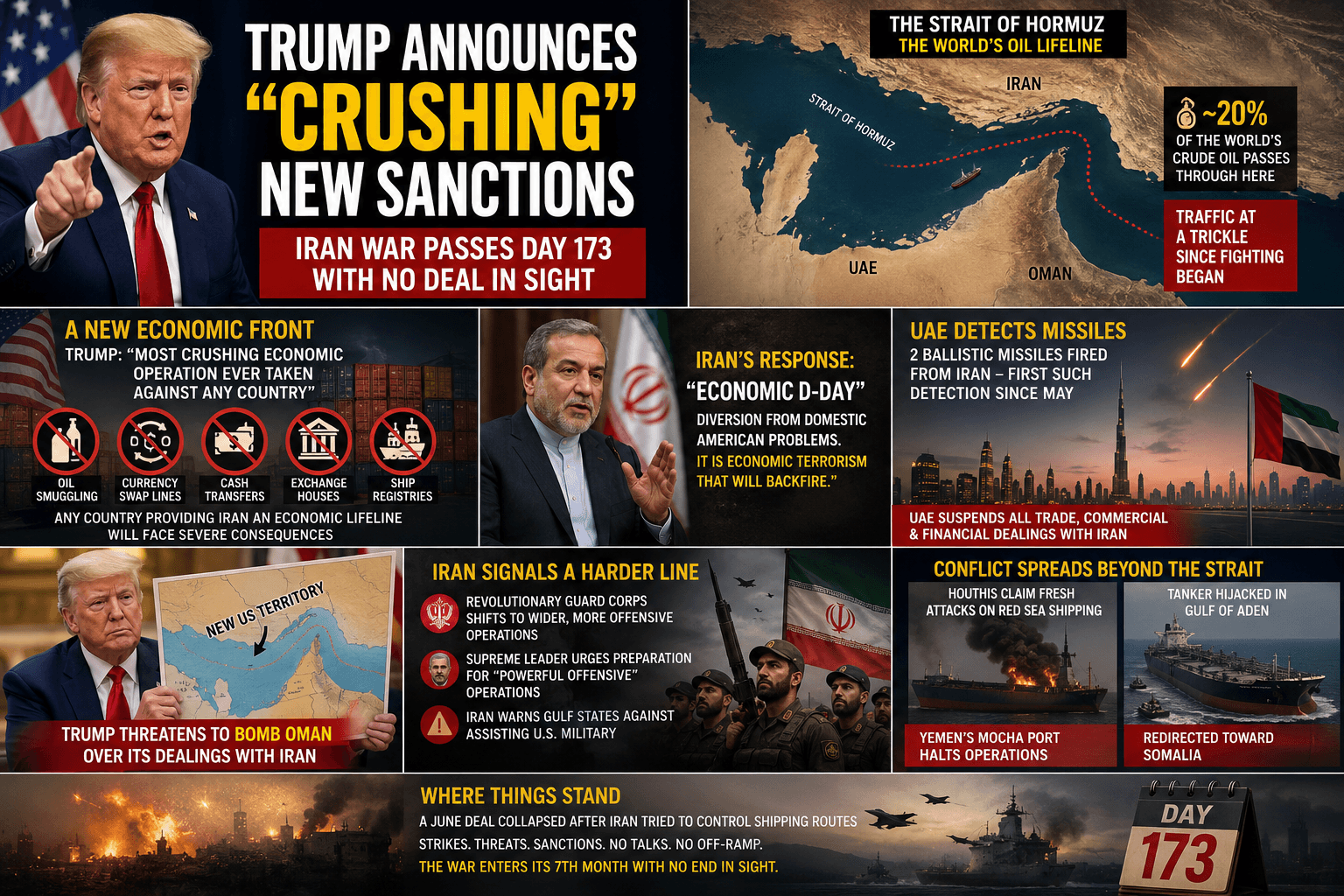
Nearly six months after the United States and Israel launched surprise strikes on Iran, the conflict shows no sign of resolution and this week, Washington shifted its strategy from military pressure toward what President Trump billed as an unprecedented economic offensive.
A New Economic Front
On Wednesday, Trump announced via social media what he described as the "MOST CRUSHING ECONOMIC OPERATION EVER TAKEN AGAINST ANY COUNTRY," warning that any nation allowing its financial institutions, businesses, airports, or government entities to provide Iran with any form of economic lifeline would itself face severe consequences. The warning specifically targeted oil smuggling, currency swap lines, cash transfers, exchange houses, and ship registries — the informal networks Iran has reportedly leaned on to keep its economy functioning under existing sanctions.
Iran's response was swift and defiant. Foreign Minister Abbas Araghchi dismissed the announcement as what he called an "economic D-Day" diversion from domestic American problems, arguing that the campaign amounted to economic terrorism that would ultimately backfire on Washington and threaten the broader global economy. The exchange underscores how far diplomatic channels have deteriorated: Trump has also stated flatly that no talks with Iran are currently underway or scheduled, despite earlier claims from his administration of an informal back channel with Iran's Islamic Revolutionary Guard Corps.
The Strait of Hormuz Remains the Flashpoint
The economic escalation follows a tense stretch centered on the Strait of Hormuz, the narrow waterway through which roughly a fifth of the world's crude oil typically passes. Traffic through the strait has slowed to a trickle since fighting began, and this week the United Arab Emirates said its air defenses detected two ballistic missiles fired from Iran — the first such detection since a May strike on a port facility — prompting the UAE to suspend all trade, commercial, and financial dealings with Iran. Tehran has called the missile allegation baseless.
Trump added to the tension by posting a map labeling the strait "New US Territory" and separately threatening to bomb Oman, a longtime U.S. ally that has tried to mediate the conflict, over its continued dealings with Iran. A former Pentagon Middle East adviser described the threat as more a sign of presidential frustration after nearly six months without resolution than a credible military plan.
Iran Signals a Harder Line
Rather than de-escalating, Iranian leadership appears to be preparing for a more aggressive posture. Iran's Revolutionary Guard Corps has reportedly signaled a shift toward wider, more offensive operations, with Supreme Leader statements urging military commanders to prepare for what was described as "powerful offensive operations." Iranian officials have also warned Gulf states against providing any assistance to the U.S. military, a message aimed at neighbors like the UAE and Oman who have historically tried to balance relationships with both Washington and Tehran.
The conflict's ripple effects continue to spread beyond the immediate region. Yemen's Houthi movement, aligned with Iran, has claimed fresh attacks on shipping in the Red Sea, prompting Yemen's Mocha port to halt operations entirely. Separately, armed individuals hijacked a tanker in the Gulf of Aden this week and redirected it toward Somalia, according to maritime security authorities — a reminder of how the war has destabilized shipping lanes far beyond the strait itself.
Where Things Stand
A memorandum of understanding reached back in June had briefly raised hopes of reopening the Strait of Hormuz and winding down hostilities, but Iran's subsequent attempts to assert control over shipping routes through the strait — including fees on passing vessels and warnings to ships that ignored its preferred routes — triggered renewed American strikes and effectively unraveled the deal. With the 60-day window originally set for a peace agreement now expired and both sides trading escalatory rhetoric rather than negotiating positions, the war that began with a decapitation strike on Iran's leadership in February shows every sign of grinding into its seventh month with no clear off-ramp in view.