
WSWall Street Takes Blockchain to the Next Level: DTCC Launches Major Tokenization Service
The crypto currency industry is facing one of its biggest security crises after Binance, the world's largest cryptocurrency exchange by trading volume, reported a massive security breach estimated at approximately $6.3 billion.
The incident, reported on October 29 and October 30, 2026, has sent shockwaves through the digital asset market. Bitcoin and Ethereum prices dropped, billions of dollars in crypto assets were frozen, and investors began questioning whether even the biggest cryptocurrency platforms can guarantee the safety of their funds.
What makes this incident particularly important is its reported scale, the speed at which the attackers moved the assets, and the possibility that the attack started with a compromised employee's computer rather than a direct attack on a blockchain.
Binance has promised to cover all confirmed losses using its Secure Asset Fund for Users (SAFU) and company funds. However, the incident has raised serious questions about cryptocurrency exchange security, internal access controls, and the future of digital asset protection.
Here is everything investors need to know about the Binance hack and what it could mean for the crypto market.
What Happened in the $6.3 Billion Binance Hack?
According to Binance's initial security update, the exchange experienced an incident involving unauthorized cryptocurrency withdrawals.
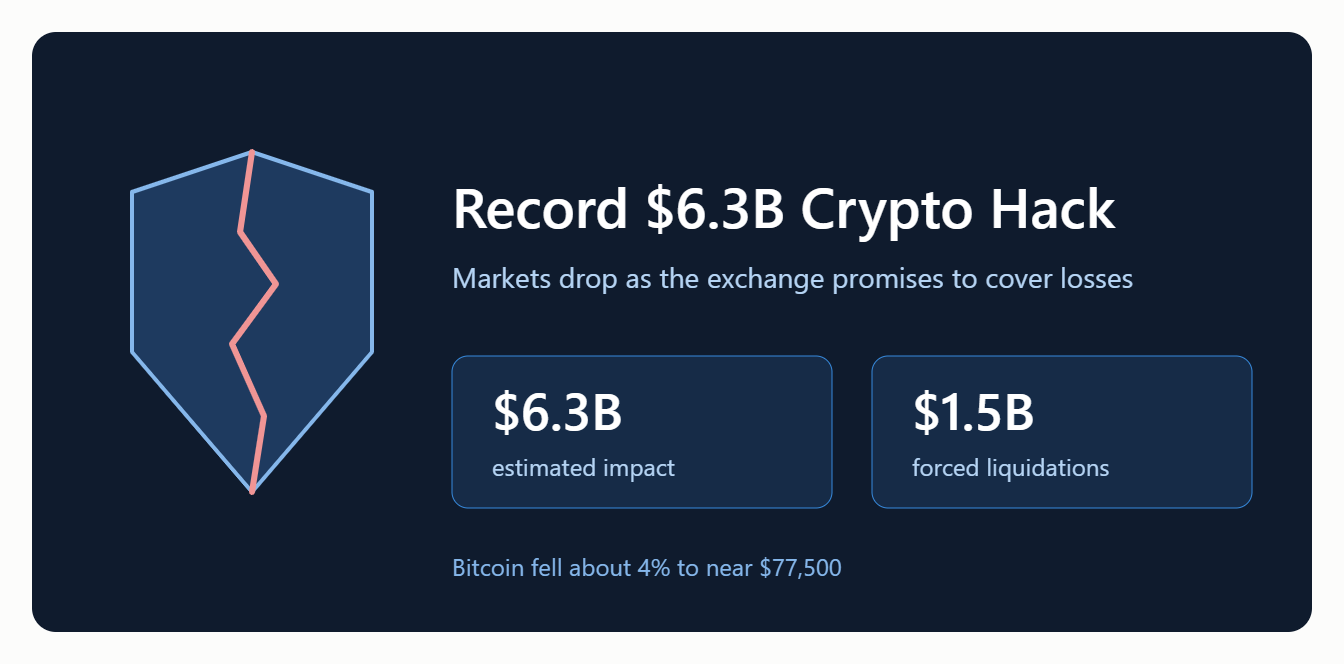
The estimated financial impact is approximately $6.3 billion, making it potentially the largest cryptocurrency theft recorded to date.
Binance reported that approximately $3 billion in affected assets had been frozen with help from blockchain partners and other industry participants.
The exchange also confirmed that it would cover all losses using its emergency protection fund and corporate resources.
In a separate update, Binance said it had arranged more than $6.34 billion to restore affected customer balances. Around $5 billion of this amount was already available in the same digital assets that had been affected, while the exchange was working to purchase the remaining tokens.
The company also stated that it had found no evidence of compromised wallet private keys in its initial investigation.
Importantly, Binance emphasized that customer funds were safe and that it would publish an updated Proof of Reserves after completing the recovery and security work.
How Did Hackers Break Into Binance?
One of the most interesting and concerning details of this incident is how the attackers may have gained access to Binance's systems.
In its October 30 update, Binance said its initial investigation suggested that a DevOps engineer's laptop may have been compromised.
DevOps engineers work with the systems and tools that help companies develop, operate, and maintain their digital platforms.
According to Binance, the compromised laptop may have allowed the attacker to access a service container and submit unauthorized withdrawal transactions.
This means the attack may not have involved stealing a wallet's private keys directly. Instead, the attackers may have exploited access to internal systems responsible for approving transactions.
Binance said it had found no evidence of a wallet private key leak, although its investigation was still ongoing.
The company also temporarily suspended deposits and withdrawals as a precaution, revoked authorization for affected addresses, and began working with law enforcement and blockchain intelligence companies.
A detailed technical investigation is expected to provide more information about the attack.
How Did Hackers Move Billions of Dollars in Cryptocurrency?
The scale and speed of the attack have attracted significant attention from blockchain security experts.
According to blockchain intelligence reports, billions of dollars in digital assets moved through multiple cryptocurrency networks and wallets.
The attackers reportedly used a combination of Bitcoin, Ethereum, stablecoins, and other digital tokens.
Blockchain analytics firm Arkham tracked wallets associated with the incident and reported that they held more than $5.7 billion in stolen cryptocurrency at one point.
The movement of these funds created a race between the attackers and cryptocurrency companies attempting to freeze the assets.
Reports from CoinDesk and other industry sources also described suspicious transactions involving decentralized exchanges and lending platforms.
For example, the attackers reportedly used stolen stablecoins as collateral to borrow wrapped Ethereum through Aave, a decentralized lending protocol.
This is an important detail because decentralized finance platforms allow users to trade, lend, and borrow cryptocurrency directly through blockchain-based smart contracts.
Attackers can sometimes use these services to exchange assets quickly and make transaction tracking more complicated.
However, blockchain transactions are generally public, meaning investigators can follow the movement of funds between wallet addresses.
Why Were $3 Billion in Crypto Assets Frozen?
One of the most significant developments following the attack was the freezing of approximately $3 billion in affected cryptocurrency assets.
Companies such as Tether and Circle played important roles in the response.
Tether, the company behind USDT, and Circle, the issuer of USDC, reportedly froze billions of dollars in stablecoins linked to the incident.
But how can cryptocurrency be frozen?
Unlike Bitcoin, certain stablecoins have centralized issuers that can restrict transfers from specific wallet addresses under their security and compliance procedures.
When suspicious funds are identified, these issuers can use their administrative controls to prevent the affected tokens from moving.
This can make it much harder for attackers to exchange or transfer those particular assets.
However, freezing cryptocurrency does not automatically mean the money has been recovered.
The funds may remain locked while companies and law enforcement agencies investigate ownership and determine the appropriate recovery process.
This distinction is important because approximately $3 billion in frozen assets does not mean the entire amount has been returned to Binance.
Is North Korea Behind the Binance Hack?
Another major development is the possible involvement of North Korean hacking groups.
Blockchain intelligence companies, including TRM Labs and Chainalysis, have reportedly linked the attack to North Korean cyber operations with a high level of confidence.
Some investigators have pointed toward the TraderTraitor group, which has been associated with previous cryptocurrency thefts.
North Korean-linked hacking groups have previously been connected to several major attacks against cryptocurrency exchanges and decentralized finance platforms.
One well-known example was the $1.5 billion Bybit hack in February 2025, which investigators attributed to North Korean hackers.
Cryptocurrency theft has become an important concern for international security agencies because stolen digital assets can be moved across borders without traditional banking transfers.
However, the Binance investigation is still developing, and the attribution should be treated as an assessment by blockchain intelligence firms rather than a final legal determination.
Bitcoin, Ethereum and BNB Prices Fall After the Attack
The security incident quickly affected cryptocurrency prices.
Investors became concerned about the potential impact on market confidence, leading to selling pressure across major digital assets.
According to market reports published on October 30:
Bitcoin (BTC) dropped more than 4%, falling below $78,000.
Ethereum (ETH) declined by approximately 4% to 5%, trading near $2,200.
Binance Coin (BNB) experienced a decline of approximately 6% to 8% during the reported sell-off.
The decline was not limited to the three largest assets connected to the incident. Other cryptocurrencies also experienced selling pressure as traders reduced their exposure to risk.
The situation became even more challenging for leveraged traders.
According to CoinDesk market reporting, approximately $1.53 billion in leveraged cryptocurrency positions were liquidated within 24 hours, including around $1.29 billion in long positions.
A long position is a trade where an investor expects the price of an asset to increase.
When prices fall sharply, exchanges can automatically close leveraged positions if traders no longer have enough funds to support them.
These forced liquidations can create additional selling pressure, sometimes making a market decline worse.
This is why a major security incident can affect cryptocurrency prices far beyond the exchange directly involved.
What Is SAFU and How Will Binance Cover the Losses?
Binance's announcement that it would cover all losses brought some reassurance to investors.
The company plans to use its Secure Asset Fund for Users, commonly known as SAFU, along with its corporate funds.
SAFU was established in 2018 as an emergency protection fund designed to help protect users during unexpected incidents.
The fund has traditionally held approximately $1 billion in Bitcoin, although its composition and value can change.
For this incident, Binance has said it has arranged more than $6.34 billion in resources to cover the estimated impact.
This is significant because it means the exchange is not relying entirely on recovering the stolen assets before restoring affected customer balances.
However, the final recovery process, confirmation of losses, and publication of updated reserve information will remain important developments.
Why Is This Hack Different From Previous Crypto Attacks?
Cryptocurrency hacks are unfortunately not new. Exchanges, blockchain bridges, decentralized applications, and individual wallets have all experienced security incidents.
However, the Binance incident stands out for several reasons.
1. The scale of the attack
An estimated $6.3 billion in affected assets makes this one of the largest reported cryptocurrency thefts in history.
2. Possible internal system access
The initial investigation points toward a compromised employee device and unauthorized access to internal infrastructure. This highlights the importance of employee cybersecurity and transaction approval systems.
3. Cross-industry cooperation
Blockchain analytics firms, stablecoin issuers, exchanges, and law enforcement agencies have worked together to trace and freeze affected funds.
4. The role of centralized stablecoins
The ability of stablecoin issuers to freeze certain assets shows how centralized controls can influence the recovery of cryptocurrency stolen during major incidents.
5. The impact on the wider market
The incident affected investor confidence and trading activity across multiple cryptocurrencies, showing how closely connected the digital asset industry has become.
What Does the Binance Hack Mean for the Future of Crypto Security?
The incident could encourage cryptocurrency exchanges to reconsider how they protect internal systems and approve large transactions.
One important area is multi-layer transaction authorization.
Instead of allowing a single compromised account or internal system to approve a major withdrawal, exchanges can introduce additional approval requirements, independent verification, and withdrawal delays for unusual transactions.
Other important security improvements include:
Hardware-based authentication for employees.
Strict access permissions for sensitive systems.
Real-time monitoring of unusual withdrawal activity.
Independent verification for large transactions.
Stronger separation between development systems and wallet infrastructure.
Regular security testing and third-party audits.
Faster cooperation between exchanges and blockchain analytics companies.
These measures cannot eliminate every possible attack, but they can make it harder for criminals to move large amounts of cryptocurrency without detection.
The incident may also increase demand for stronger security standards across centralized exchanges and decentralized finance platforms.
What Should Cryptocurrency Investors Do Now?
The Binance incident is a reminder that cryptocurrency investors should take personal security seriously.
Even if an exchange promises to cover losses, investors should not depend entirely on a trading platform to protect their assets.
Here are some practical steps:
Use secure wallets: Consider hardware wallets for long-term cryptocurrency holdings. Keep recovery phrases offline and never share them.
Enable two-factor authentication: Use an authenticator app or hardware security key wherever possible.
Avoid excessive leverage: Leveraged trading can increase losses during sudden market movements.
Verify official announcements: Never trust random messages claiming to offer compensation or recovery services.
Diversify platform exposure: Avoid keeping all your digital assets on a single exchange.
Check withdrawal addresses: Always verify wallet addresses before sending cryptocurrency.
Stay alert to phishing attacks: Criminals often use major security incidents to create fake Binance support accounts, recovery websites, and compensation offers.
Remember, legitimate exchanges will not ask you to share your password, private key, or wallet recovery phrase to receive compensation.
What Happens Next? Five Important Things to Watch
The coming days will be important for understanding the full impact of the Binance security incident.
Investors and industry analysts will be watching several developments.
1. Binance's final investigation report
The detailed technical report should explain how the attackers gained access and what security changes will be introduced.
2. Recovery of stolen cryptocurrency
Blockchain investigators will continue tracking affected wallets and working with industry partners to recover or freeze additional funds.
3. Resumption of normal withdrawals
The exchange's withdrawal services will be an important indicator of progress in its security review.
4. Bitcoin and Ethereum price movements
Investors will monitor whether Bitcoin can regain lost ground and whether Ethereum and other major cryptocurrencies can stabilize.
5. New exchange security standards
The incident could encourage exchanges to introduce stronger withdrawal controls, improved employee security, and better cooperation during major cyberattacks.
Final Thoughts: A Major Warning for the Cryptocurrency Industry
The $6.3 billion Binance hack is more than another cryptocurrency security incident. It is a major warning about the risks associated with managing billions of dollars in digital assets.
The attack has highlighted how a compromised employee device, weaknesses in internal transaction controls, and sophisticated blockchain activity can create serious problems for even the largest cryptocurrency platforms.
Binance's commitment to cover all losses and the freezing of approximately $3 billion in affected assets have provided some reassurance. However, the industry still needs answers about the full attack method, the recovery of remaining assets, and the effectiveness of new security measures.
For cryptocurrency investors, the biggest lesson is simple: digital asset security should never be taken for granted.
As the investigation continues, the world will be watching how Binance responds and whether the incident leads to stronger protection across the entire cryptocurrency ecosystem.
Disclaimer: This article is for informational and educational purposes only. It does not constitute financial or investment advice. Cryptocurrency markets are highly volatile, and investors should conduct their own research before making financial decisions.