

Introduction
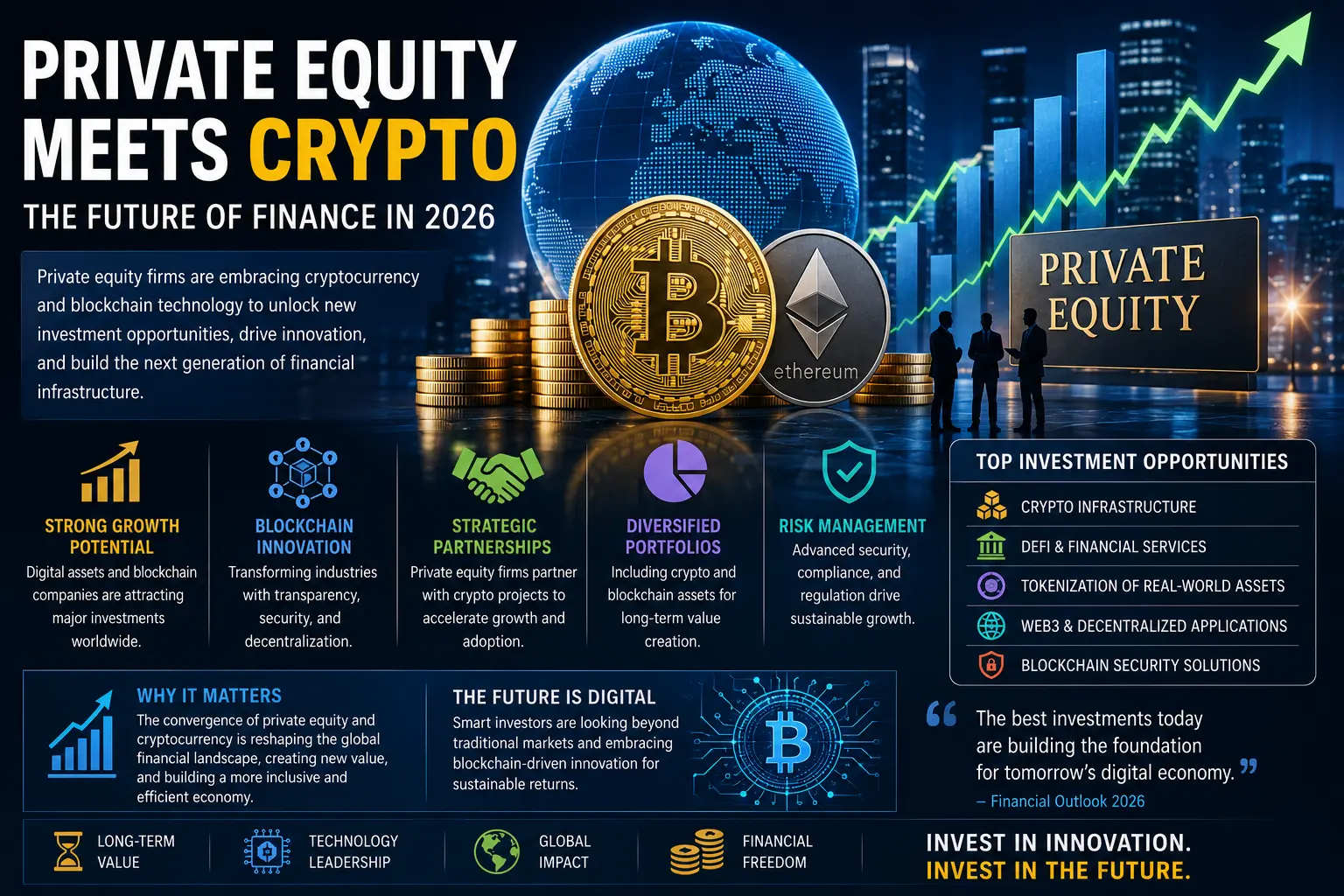
The global investment landscape is undergoing a profound transformation as private equity firms, venture capital investors, and financial institutions expand beyond traditional asset classes to explore blockchain technology and digital assets. What was once viewed as a niche innovation has matured into an ecosystem supporting decentralized finance (DeFi), tokenization, enterprise blockchain, digital payments, and institutional investment.
Rather than treating cryptocurrency as a speculative market alone, many investors are focusing on the businesses and infrastructure that power the digital economy. This shift reflects growing confidence in blockchain's long-term commercial potential, improving regulatory clarity, and rising demand for financial innovation.
As institutional capital flows into blockchain-enabled businesses, the relationship between private equity and cryptocurrency is becoming one of the defining investment stories of 2026.
Private Equity Is Investing in Digital Infrastructure
Private equity firms have traditionally focused on acquiring established companies, improving operations, and generating long-term value before exiting through acquisitions or public offerings.
Today, that strategy is expanding.
Many firms are investing in companies developing blockchain infrastructure, AI-powered financial software, cybersecurity solutions, payment technologies, and enterprise fintech platforms.
Instead of chasing short-term cryptocurrency price movements, institutional investors increasingly favor businesses that generate recurring revenue by providing essential infrastructure for the digital asset economy.
Cryptocurrency Is Becoming Part of Institutional Investment Strategies
The cryptocurrency market has evolved significantly over the last decade. Bitcoin and Ethereum remain foundational digital assets, but institutional interest now extends to tokenization platforms, decentralized finance applications, blockchain payment networks, and digital identity solutions.
Large investment firms are evaluating blockchain technology as a long-term innovation capable of improving financial efficiency, reducing settlement times, and enabling new investment models.
Although digital assets remain volatile, many institutions view blockchain as a strategic technology rather than simply a speculative asset class.
Blockchain Infrastructure Is Attracting Long-Term Capital
One of the fastest-growing investment areas is blockchain infrastructure.
Private equity firms are supporting companies that develop:
Digital asset custody solutions
Enterprise blockchain platforms
Crypto payment infrastructure
Blockchain cybersecurity
Regulatory technology (RegTech)
Tokenization platforms
Web3 development tools
Cross-border payment solutions
These businesses provide the technology behind the digital asset ecosystem and often generate revenue regardless of cryptocurrency market cycles.
Tokenization Is Redefining Asset Ownership
Asset tokenization is emerging as one of the most promising developments in modern finance. By representing ownership of real-world assets on blockchain networks, tokenization can improve liquidity, reduce transaction costs, and enable fractional ownership.
Assets increasingly being explored for tokenization include:
Commercial real estate
Private equity funds
Infrastructure projects
Company shares
Commodities
Intellectual property
Collectibles and fine art
Financial institutions believe tokenization could modernize capital markets by making investment opportunities more accessible and efficient.
Artificial Intelligence and Blockchain Are Converging
Artificial intelligence and blockchain are increasingly being deployed together to create more intelligent and secure financial systems.
AI supports:
Fraud detection
Risk management
Investment analysis
Portfolio optimization
Regulatory compliance
Smart contract monitoring
Meanwhile, blockchain provides transparent, immutable records that strengthen trust and security. Together, these technologies are helping financial institutions automate operations while improving decision-making.
Fintech Innovation Continues to Accelerate
Fintech remains one of the strongest areas for private equity investment. Companies building embedded finance platforms, digital banking solutions, AI-driven financial tools, and blockchain-based payment systems continue to attract institutional capital.
Growing consumer demand for faster, more secure, and personalized financial services is encouraging continued investment across the sector.
Cross-Border Payments Are Being Reimagined
Traditional international payment systems often involve high fees and lengthy settlement times. Blockchain-based payment networks offer the potential for faster, more transparent, and cost-effective cross-border transactions.
While conventional banking systems remain dominant, financial institutions are increasingly experimenting with blockchain technologies to improve payment efficiency and reduce operational costs.
Regulatory Clarity Is Supporting Institutional Adoption
Governments and financial regulators around the world continue to refine digital asset regulations. Although approaches vary by jurisdiction, clearer compliance frameworks are improving investor confidence and encouraging responsible innovation.
For institutional investors, regulatory certainty reduces legal risk and supports long-term investment planning.
Challenges Facing Investors
Despite strong momentum, investors continue to navigate several challenges:
Digital asset price volatility
Cybersecurity threats
Regulatory differences across jurisdictions
Scalability of blockchain networks
Consumer education
Rapid technological change
Successful investors address these risks through diversification, disciplined risk management, and long-term investment strategies.
Investment Themes to Watch in 2026
Several sectors continue attracting institutional interest:
Blockchain infrastructure
Artificial intelligence
Financial technology
Tokenized assets
Digital payment networks
Cybersecurity
Enterprise software
Cloud computing
Rather than focusing solely on cryptocurrency prices, investors are increasingly evaluating companies that provide the technology supporting the broader digital economy.
Why Portfolio Diversification Matters
Diversification remains a cornerstone of successful investing. Modern portfolios increasingly combine traditional and alternative asset classes, including:
Public equities
Private equity
Fixed income
Real estate
Infrastructure
Technology companies
Alternative investments
Select digital assets
A diversified portfolio can help reduce overall risk while providing exposure to multiple long-term growth opportunities.
The Future of Digital Finance
Financial markets are becoming more digital, automated, and interconnected. Blockchain, artificial intelligence, and tokenization are expected to reshape how capital is raised, invested, and transferred over the coming decade.
Rather than replacing traditional finance, these technologies are complementing existing financial systems by improving efficiency, transparency, and accessibility. Organizations that invest in scalable infrastructure and innovation are likely to play a central role in the future of global finance.
Conclusion
The convergence of private equity, blockchain technology, and digital assets represents one of the most significant developments in today's financial markets. Institutional investors are increasingly shifting their focus from speculative cryptocurrency trading toward long-term investments in the infrastructure powering the digital economy.
As blockchain adoption expands and regulatory frameworks mature, opportunities are emerging across fintech, tokenization, cybersecurity, digital payments, and enterprise software. Investors who understand these structural changes—and maintain a disciplined, diversified approach—will be better positioned to capitalize on the next phase of financial innovation.