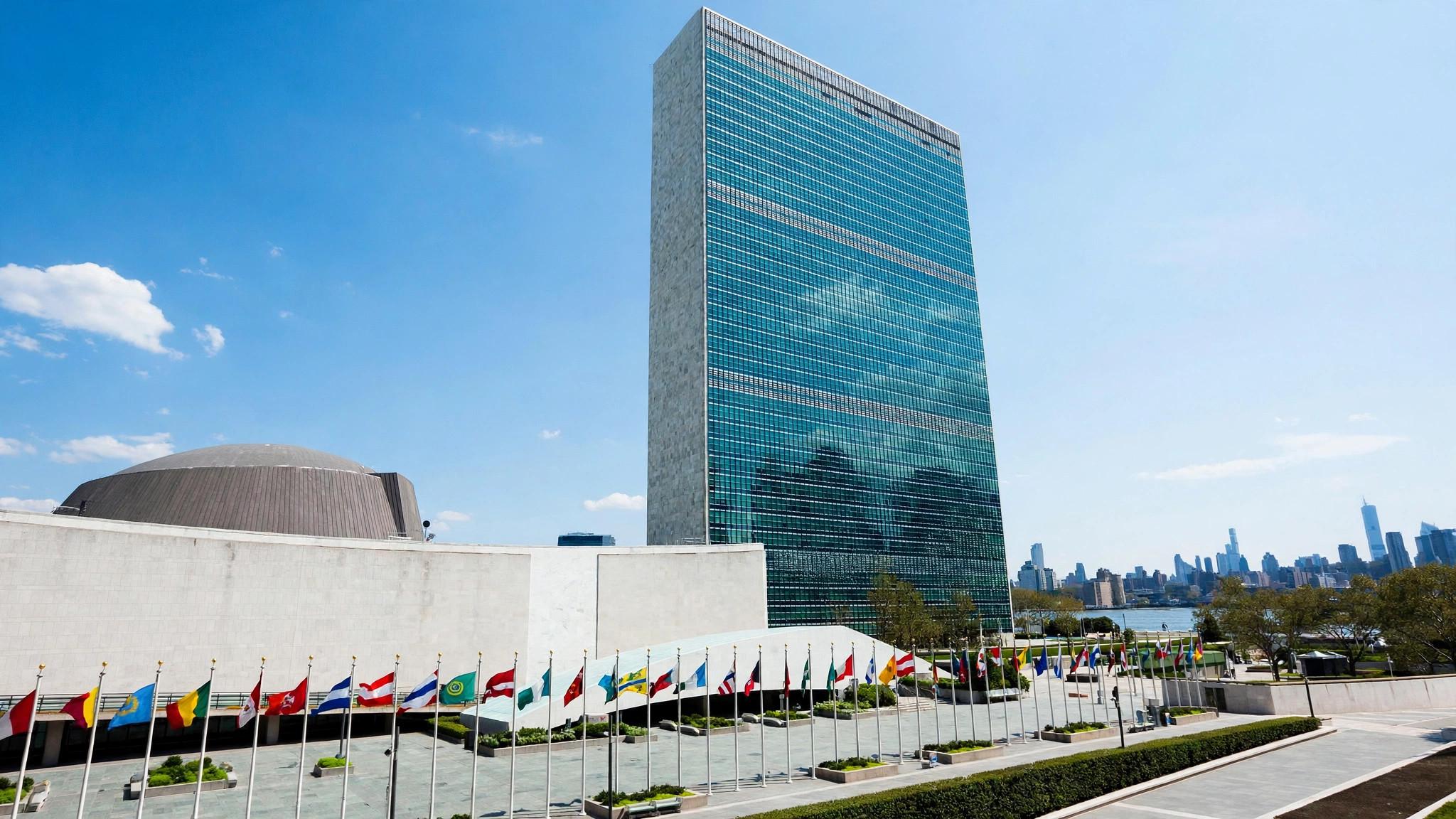

The world needs rules for artificial intelligence — and it needs them fast. That was the message from United Nations Secretary-General Antonio Guterres on Monday, when he called on member states to develop, within the next year, a multilateral framework for managing the risks related to AI. It is the clearest deadline yet from the world's top diplomat for governing a technology that is moving faster than any government on Earth.
The timing was no accident. Guterres spoke on the same day that Nvidia, the company at the heart of the AI boom, completed one of the wildest corporate reversals in history — a saga that showed, in vivid detail, exactly why the governance gap around AI has become impossible to ignore.

What Did the UN Chief Actually Call For?
Guterres called on member states to work together, through the United Nations, to build a multilateral framework for managing AI risks within the next year. The emphasis is on "multilateral" — rules agreed between countries, not imposed by one government or left to a handful of tech companies.
The call stops short of proposing a specific treaty or institution. No draft text, no enforcement mechanism and no list of signatories has been put forward. What Guterres has done is set a clock: one year for the world's governments to agree on how they intend to manage a technology that already shapes economies, elections, warfare and everyday life.
How Did One Week of AI Chaos Make His Case?
If Guterres needed an exhibit, the past 11 days provided a perfect one. Nvidia's chief executive Jensen Huang stepped down on 11 November, the board said on 17 November that it would not reinstate him, and then on 23 November it unanimously brought him back — after consulting senior US government officials and with public backing from President Donald Trump.
In between, roughly a trillion dollars of market value swung back and forth. Nvidia's shares soared 31% on Monday alone, the biggest one-day dollar gain in stock market history, after falling around a third from their late-October highs. A single leadership decision at a single company moved more money in a day than most countries produce in a year — and it took direct government intervention to resolve.
The episode also raised questions no existing rulebook clearly answers: how should governments treat the leaders of companies that control the world's most powerful chips, what happens when national security concerns collide with market stability, and who decides when a CEO's personal conduct becomes a matter of state? Congressional inquiries into chip exports to Southeast Asia and China continue, adding another layer of political scrutiny to a company that is now, effectively, a strategic national asset.
What Could Global AI Rules Actually Cover?
A global framework for AI could, in principle, cover several areas where countries already agree that some coordination is needed.
First, safety standards: shared testing and reporting requirements for the most powerful AI models, so that a system judged safe in one country is not deployed recklessly in another. Second, export controls: clearer, more consistent rules on who can buy advanced AI chips and why — the very issue at the centre of the congressional inquiries into Nvidia's exports. Third, transparency: common expectations that companies disclose how their most capable systems are built, tested and used.
What Can Global Rules Not Do Quickly?
For all the urgency, there are hard limits on what a one-year framework can achieve. Countries disagree sharply on the fundamentals: how much AI development should be controlled, who gets access to the most advanced chips, and whether AI safety or AI competition matters more. The United States, China and Europe are not starting from the same place, and none of them is likely to surrender control over a technology they see as central to their economic and military future.
Enforcement is another problem. The UN has no power to compel a tech company to change its behaviour, and any framework agreed in New York would still depend on national governments to implement it. A set of voluntary principles is achievable within a year; a binding treaty with real teeth is not.
There is also the question of speed. AI capabilities are advancing in months, while international negotiations are measured in years. Even if member states meet Guterres's deadline, the rules they agree on may already be behind the technology they are meant to govern — Google's quantum chip recently beat classical limits in an "impossible game" , a reminder that the frontier of computing keeps moving. The tension is visible even in smaller steps toward AI safety: Signal recently blocked screenshots to stop AI agents reading private chats , a sign that even the most privacy-conscious companies are scrambling to adapt to AI systems that can see and read everything on a screen.
Why Does This Deadline Matter?
Deadlines matter in diplomacy because without one, nothing happens. By putting a one-year clock on AI governance, Guterres has given governments a target they can be judged against — and given the public a way to measure whether the world's leaders are serious.
The Nvidia saga showed what is at stake when governance fails: a leadership crisis at one company became a market crisis, a political crisis and a national security debate within days. AI is no longer a technology story. It is an economic, political and security story — and the rules for it are still, essentially, unwritten.
Final Thoughts
Guterres's call for global AI rules within a year is ambitious, and the obstacles are real: rival governments, competing interests, and a technology that refuses to slow down. But the events of the past week have made the case better than any speech could. When a single CEO's fate can move a trillion dollars and draw in a president, the gap between AI's power and the world's ability to govern it is no longer theoretical.