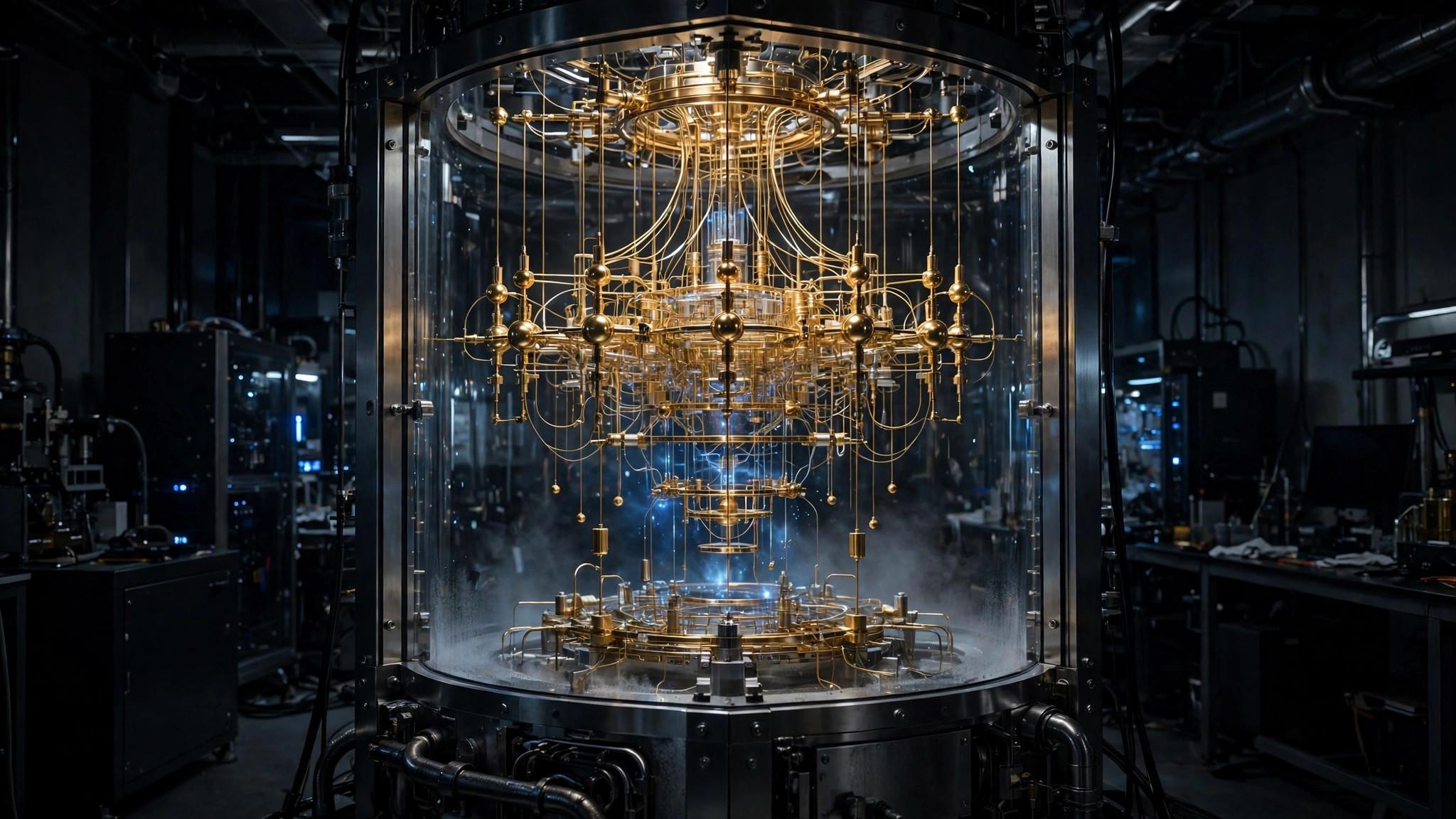
Google's quantum chip has beaten classical limits in an "impossible" game, as reported today — a result that sounds like science fiction but sits at the heart of one of the most important races in computing. The headline is dramatic, but it is easy to misunderstand, so it is worth asking what actually happened, what it means, and what it does not mean.
Quantum computing has been promised as the next great leap for decades. This result is the latest sign that the leap is getting closer — even if it is not here yet.

What Is a Quantum Chip?
Start with the basics: the computer in your phone or laptop works with bits — tiny switches that are either on or off, 1 or 0. Everything it does, from opening an app to streaming a video, is built from billions of these simple choices.
A quantum chip works with a different building block: the qubit, which can exist in a combination of states at once rather than being simply on or off. For certain problems, a quantum machine can explore many possible answers at the same time, while a classical computer must work through them one by one.
That is why quantum computers are not simply faster versions of ordinary computers. They are a different kind of machine, suited to different kinds of problems — and the challenge for researchers has always been proving that this different kind of machine can actually do something a classical computer cannot.
What Does "Beating Classical Limits" Mean?
When researchers say a quantum chip has beaten classical limits, they mean it has solved a problem, or passed a test, in a way that no ordinary computer could match within a reasonable time or with reasonable resources. The "limit" is the boundary of what classical computing can do — and crossing it is the whole point of building quantum machines in the first place.
It is genuinely hard to do: quantum states are fragile, and the slightest disturbance — a tiny temperature change, a stray vibration — can destroy the conditions it needs. Keeping a system stable long enough to outperform a classical computer is an engineering achievement as much as a scientific one.
Why Do Researchers Use an "Impossible" Game?
The word "game" might make this sound like a toy problem, but that misses the point. Researchers use carefully designed games and benchmarks because they need a fair, precise way to compare two very different kinds of machine.
A game-like test has clear rules, a winner, and a result that can be checked. If a quantum chip wins a game classical computers cannot win — one designed so the best classical strategy is provably limited — then the result is unambiguous. There is no room for argument about whether the classical computer was simply not trying hard enough. The game sets the terms, and the quantum chip beat them.
Think of it like a race on a fixed track: the game is the track, and beating the classical limit is finishing it in a way no ordinary runner could. The game is not the destination — it is the proof that the machine works.
What Does This Mean for Computing?
The result matters because computing is in the middle of a wider race. An AI model price war is already under way, with GPT-6.2, Gemini 4 Neon and Qwen4-Max cutting agent costs in a week, and the competition to build cheaper, more powerful AI is reshaping the industry. Quantum is the next frontier of that race: whoever masters it could gain an edge in problems today's machines struggle with, from designing new materials and medicines to optimising complex systems.
Google's own AI work shows how fast the frontier is moving — its new mid-tier model is already turning heads, as Google Gemini 4 Neon explained — the model that beat its own flagships shows — and quantum sits alongside it as a longer-term bet on a fundamentally different kind of power.
What Does It NOT Mean Yet?
This is the part that matters most for anyone reading the headlines. A quantum chip beating classical limits in a benchmark game does not mean any of the following:
No consumer impact yet. Quantum computers will not speed up your phone, your laptop, or your internet connection. They are specialised machines for specialised problems, and they live in research labs, not in homes.
No immediate threat to everyday encryption. The idea that quantum computers will break the encryption protecting your bank account and messages is a real long-term concern, but this result brings it no closer in practical terms. The machines capable of that are still far away, and the security world is already working on defences.
Practical quantum computers are still years away. Beating a benchmark is not the same as solving a useful real-world problem, and turning a laboratory result into a reliable machine for everyday work remains a major engineering challenge.
In short, the result is a milestone on a long road, not the end of it.
Why Does This Still Matter?
If practical quantum computers are years away, why care about a game result today? Because milestones like this are how long roads get travelled: each time a quantum chip does something classical computers cannot, researchers learn how to build bigger, more stable machines, confidence grows, and the next milestone gets closer.
Final Thoughts
Google's quantum chip beating classical limits in an "impossible" game is a genuine achievement. It shows quantum machines can do things ordinary computers cannot, and it keeps momentum building toward the next frontier of computing. But keep it in perspective: this is a laboratory milestone, not a product launch. No consumer will notice a difference tomorrow, no encryption is about to break, and practical quantum computers remain years away. The real story is quieter than the headline suggests — a new kind of computer is slowly, steadily, starting to work.