
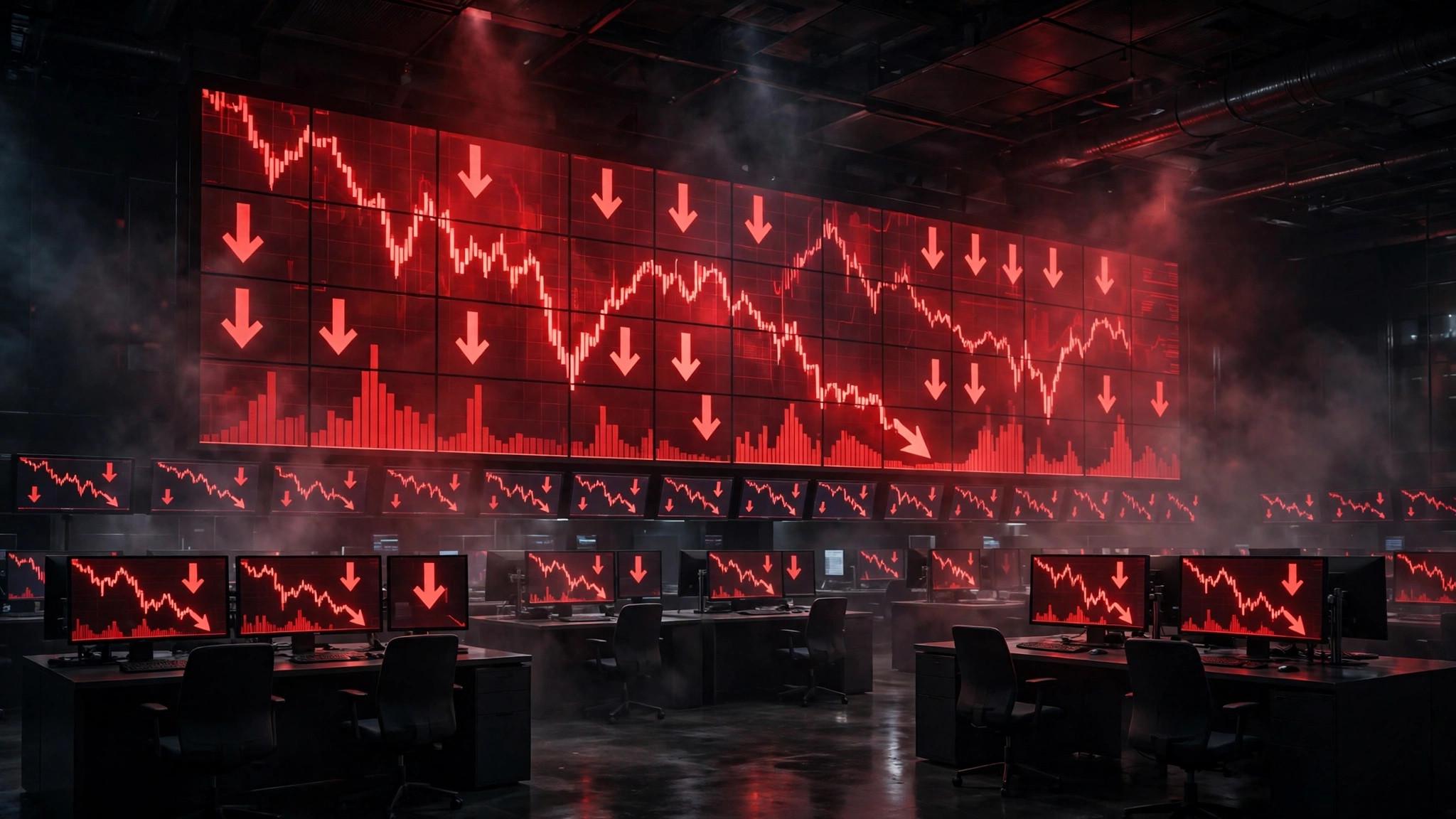

Wall Street ended one of its ugliest weeks in years on Friday, with the Nasdaq Composite suffering its worst weekly fall since 2020. The tech-heavy index dropped 5.28% on Friday alone and 10% for the week, as a sell-off that began in high-flying artificial intelligence stocks spread across the market. The S&P 500 fell 3.7% on Friday and the Dow Jones Industrial Average lost 1.93%, leaving both major benchmarks in correction territory — more than 10% below their record highs. Only weeks ago, markets were celebrating a relentless AI-powered rally. Now, questions about stretched valuations, an accounting probe at the market's most important company, and fading risk appetite have combined into a sharp reversal.
What Happened on Friday?
Friday was the worst day of a bad week. The Nasdaq's 5.28% drop was its steepest single-day fall of the sell-off, and it capped a 10% weekly decline — the index's worst week since the pandemic crash of 2020. The S&P 500's 3.7% Friday fall and the Dow's 1.93% decline confirmed that the rout was no longer confined to technology stocks. Semiconductors were at the centre of the storm. The chip sector fell 10.7% on Friday, a dramatic one-day move for a group that had been the engine of the market's gains. Nvidia, the world's most valuable company and the symbol of the AI boom, plunged 14% on Friday and 23% for the week after reports of an SEC accounting probe — a stunning reversal for a stock that had carried the entire market higher for much of the year.
Why Did the Nasdaq Fall So Sharply?
The sell-off has several drivers, and they reinforced each other as the week went on. First, valuations in the AI trade had become stretched after months of gains, leaving little room for disappointment. Second, the reported SEC probe into Nvidia's accounting gave investors a concrete reason to question the sector's most important name. Third, once selling began, it fed on itself as funds rushed to cut risk at the same time. The Nasdaq, heavily weighted toward technology and growth stocks, was always the most exposed index to an AI-led reversal. The declines in the S&P 500 and Dow show the selling then spread beyond tech, as investors sold across the board to raise cash. This is not the market's first shock this week. The S&P 500's 3.7% slide came after Wall Street had already lost around $7 trillion in value, and the pain has now spread well beyond equities — Bitcoin has fallen to a two-year low as global markets sink.
Which Stocks Were Hit Hardest?
Nvidia — down 14% on Friday and 23% for the week on reports of an SEC accounting probe, the worst performer among the market's giants.
Semiconductors broadly — down 10.7% on Friday alone, as the chip sector gave back a large share of its recent gains in a single session.
High-growth technology — the Nasdaq's 10% weekly fall shows that the selling hit growth stocks across the board, not just one or two names.
The broader market — the S&P 500 and Dow both entering correction shows that even defensive and industrial names were not spared.
What Does a Correction Actually Mean?
A correction is generally defined as a fall of more than 10% from a recent peak. Both the S&P 500 and the Dow have now crossed that line, while the Nasdaq's 10% weekly drop puts it in similar territory. Corrections are a normal part of market cycles — they have happened regularly throughout history, even in strong bull markets — but they still hurt, especially when they arrive as quickly as this one has. The speed matters: a gradual 10% decline over months gives investors time to adjust, while a 10% fall in a single week is a shock that tends to produce more volatility as investors reassess what they own.
Are Investors Buying the Dip?
Despite the rout, investors poured a net $59.23 billion into global equity funds in the week to 18 November — a reminder that many long-term investors still see dips as buying opportunities. That flow, however, came before the worst of Friday's selling, so it remains to be seen whether the appetite to buy survives the weekend. Sharp weekly falls often lead to sharp rebounds, but they can also be the first leg of a deeper decline — much depends on whether the Nvidia concerns prove a passing scare or a serious reassessment of the AI trade.
What Should Investors Watch Next?
Any further news on the Nvidia probe — clarity, or the lack of it, will set the tone for the whole semiconductor sector.
Whether the S&P 500 and Dow stabilise — further heavy selling early in the week would deepen the correction and could trigger more forced selling.
Safe-haven assets — even gold, long seen as the ultimate safe haven, has plunged this week, suggesting investors are selling almost everything to raise cash.
Fund flows — whether the billions that flowed into equity funds keep coming will show if buyers are stepping in or standing aside.
Final Thoughts
The Nasdaq's worst week since 2020 and the S&P 500 and Dow entering correction mark a decisive break from the market mood of recent months. The AI trade that powered the rally is now dragging it down, and Nvidia's 23% weekly fall shows how quickly sentiment can turn. Corrections are painful but normal, and the billions still flowing into equity funds suggest many investors are not giving up on stocks — but the coming week will test whether this was a short-lived scare or the moment the long rally finally ran out of room.
Disclaimer: This article is for informational purposes only and does not constitute financial advice. Stock market investing involves risk, including the possible loss of principal. Past performance is not a guarantee of future results. Readers should do their own research or consult a licensed financial adviser before making investment decisions.