
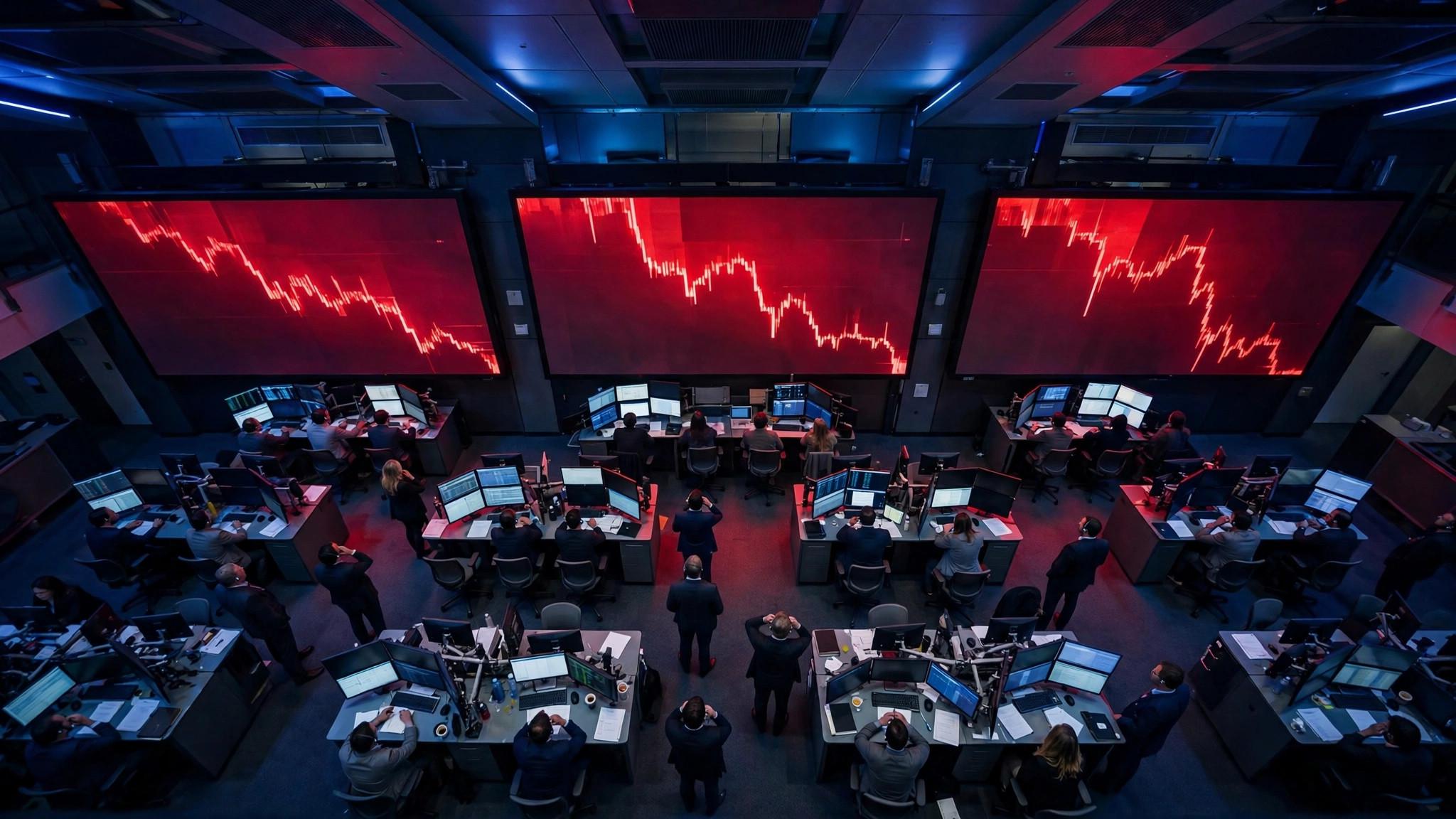
Wall Street has just had one of its worst weeks in years. The S&P 500 sank 3.7% in a single week, the Nasdaq slipped into negative territory for the year, and around $7 trillion in market value was wiped out as investors rushed out of stocks and into safer assets.
The sell-off hit almost everything at once: technology stocks, cryptocurrencies, and even gold took a beating before recovering. For readers following our coverage of the Bitcoin price crash below $57,000, the stock market crash is part of the same global move away from risk.
What Happened in the Stock Market Crash This Week?
The numbers tell the story of a week when confidence simply broke:-
The S&P 500 fell 3.7% over the week, one of its sharpest weekly declines of the year.
-
The Nasdaq Composite dropped into negative territory for 2026, giving up all of its gains for the year.
-
Nvidia, the poster child of the AI boom, suffered its worst week since 2008, falling around 23%.
-
Around $7 trillion in market value was wiped from Wall Street, according to market estimates.
-
Bitcoin fell below $57,000 in the same week, showing that the risk-off mood had spread well beyond equities.
Selling was broad-based — not one bad earnings report, but a market-wide rush for the exit.
Why Did the Stock Market Crash?
Analysts point to several pressures hitting the market at the same time:-
The AI trade is unravelling. The market's rise was driven by a small group of AI giants, and when Nvidia fell 23% in a week, the whole market followed.
-
Rising real yields. Inflation-adjusted US Treasury yields have climbed as investors brace for a more hawkish Federal Reserve, making government bonds more attractive than stocks.
-
Valuation fears. After years of gains, many of the largest technology stocks were trading at very high valuations. The market was vulnerable to any bad news — and this week it got plenty.
-
Record outflows from risk assets. Money is leaving not just stocks but also Bitcoin ETFs, with BlackRock's IBIT recording a record $541.1 million single-day outflow on 19 November.
-
Contagion across markets. Losses in one asset class pushed investors to cut risk everywhere else, in a cycle that fed on itself.
Which Stocks Were Hit Hardest?
Technology and AI stocks bore the brunt of the sell-off:-
Nvidia led the decline with a roughly 23% weekly fall, its worst week since the 2008 financial crisis.
-
Other major AI and semiconductor names followed Nvidia lower as investors questioned whether AI spending would deliver the returns promised.
-
Growth stocks across the Nasdaq were hit harder than the broader market, which is why the Nasdaq has now turned negative for the year.
-
Defensive sectors — staples, utilities and healthcare — held up better, but even they could not escape the week.
The pattern is familiar: when a market driven by a handful of high-growth names turns, those names fall the fastest.
How Big Is the $7 Trillion Loss?
A $7 trillion loss sounds abstract, but it represents a meaningful slice of total US household wealth, much of which sits in retirement accounts and pension funds. For ordinary savers, the impact shows up in 401(k) statements and pension valuations — a theme we explore in our look at what the market loss means for ordinary families' savings and pensions.The loss is, for now, a paper loss. But it is large enough to change how people feel about spending and investing — and that is where market crashes start to affect the real economy.
What Does This Mean for Ordinary Investors?
For most people, the question is simple: sell, buy, or do nothing? History offers some useful perspective:-
Market corrections of this size are painful but not unusual — the S&P 500 has averaged roughly one 10% correction per year over its history.
-
Selling after a big drop usually locks in losses; the market's best days often arrive close to its worst days.
-
Diversification matters most exactly when it feels least useful — bonds, cash and gold all behaved differently from stocks this week.
-
Long-term investors who stayed invested through previous crashes, including 2008 and 2020, were rewarded over time.
None of this makes a 3.7% weekly fall comfortable. But sharp sell-offs are part of how markets work, not a sign that the system itself is broken.
What Should Investors Watch Next?
Five things will decide whether this is a correction or the start of something deeper:-
The Federal Reserve's next signals on interest rates and inflation.
-
Whether Nvidia and other AI leaders can stabilise after this week's heavy selling.
-
Daily ETF flow data — continued outflows would signal that institutional investors are still de-risking.
-
US Treasury yields: a further rise would keep pressure on stocks.
-
The next round of earnings, including the big technology names, as investors reassess what AI spending is worth — the same questions raised during Big Tech earnings week.
The upcoming IPO of Anthropic, the largest US IPO on record, will also be a key test of investor appetite. Our analysis of the Anthropic IPO and how it changes the business of AI explains why that debut matters far beyond the AI industry.
Final Thoughts
This week was a reminder that markets can turn fast. A 3.7% weekly fall in the S&P 500, a $7 trillion loss and Nvidia's worst week since 2008 are not everyday events — but they are not the end of the story. What matters now is whether the Federal Reserve, earnings and the AI trade can give investors a reason to buy again. Until then, expect volatility to stay high.Disclaimer: This article is for informational and educational purposes only and does not constitute financial advice. Stock market investing involves risk, including the possible loss of principal; do your own research or consult a qualified financial adviser before making any investment decision.